A Filename Is Not Metadata
Introduction
Most organizations think they have metadata because they have file names, folder structures, and a data catalog. They don't. They have an inventory. Metadata is a different thing entirely, and the gap between the two is exactly where AI systems fail.

Date
08.11.26
Author
Voyager Editorial Team
Type
Insights
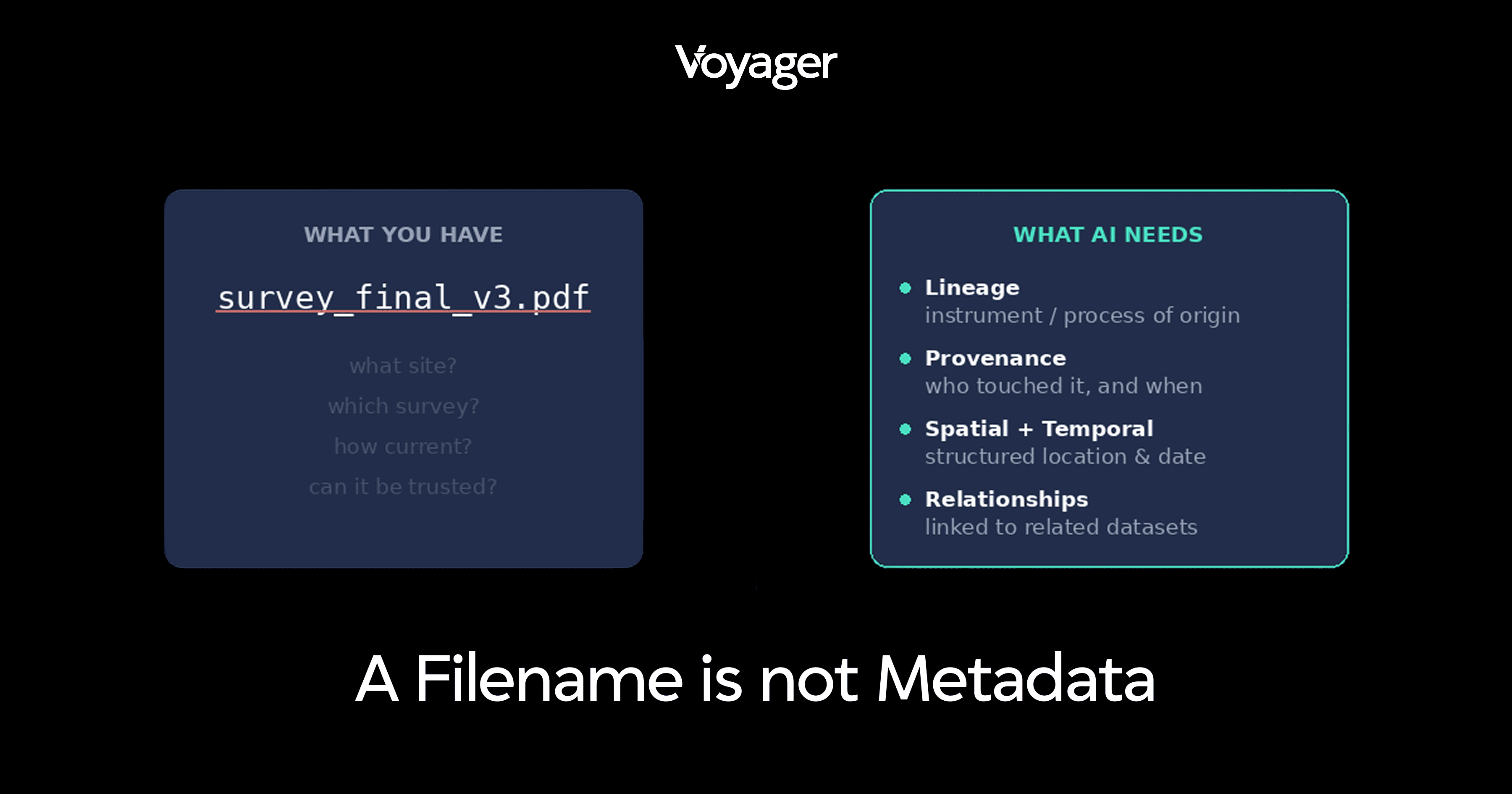
A file called survey_final_v3.pdf tells you almost nothing. Not what survey, not which site, not whether "final" means final or just the last version someone remembered to rename before moving on to the next project. It's a label, not a description.
Most organizations mistake the label for the description. They point to their folder structure, their naming conventions, their data catalog, and call it metadata. It isn't. It's an inventory, a list of what exists and roughly where. Metadata is what tells you what a piece of data actually is: where it came from, when it was collected, what it relates to, and whether it can be trusted.
A catalog answers "does this file exist and where is it." Metadata answers "what is this, and can I rely on it." Those are different questions, and only one of them is useful to an AI system trying to reason over your data instead of just retrieving it.
Why the difference didn't matter as much before
For years, this gap was survivable. A person searching for a file could open it, skim it, and use judgment to fill in what the filename left out. A geologist who found survey_final_v3.pdf could tell in thirty seconds whether it was the site they needed, roughly how old it was, and whether to trust it. The inventory got you close enough, and a human closed the gap.
AI systems don't have that judgment, and they don't get the thirty seconds. An AI system asked to reason over that same file has a filename, a file type, and whatever text it can extract, but no way to independently verify when the survey was run, what equipment produced it, or whether a newer, contradictory survey exists somewhere else in the same file system. It can retrieve the file. It can't tell you if the file is right.
What real metadata actually captures
Lineage: where the data came from, and what process produced it — a specific instrument, a specific survey, a specific acquisition.
Provenance: who touched it and when, so a decade-old field report doesn't get treated with the same confidence as last week's sensor reading.
Spatial and temporal context: not just that a dataset mentions a location or a date, but that location and date captured as structured, queryable information — not buried in paragraph three of a scanned PDF.
Relationships: how one dataset connects to another, so a system can recognize that two files describe the same site, the same asset, or the same time period, even when nothing about their filenames says so.
None of this shows up in a file name. Most of it doesn't show up in a data catalog, either, because a catalog is built to tell you what exists, not to describe what any one thing means.
Lineage: where the data came from, and what process produced it — a specific instrument, a specific survey, a specific acquisition.
Provenance: who touched it and when, so a decade-old field report doesn't get treated with the same confidence as last week's sensor reading.
Spatial and temporal context: not just that a dataset mentions a location or a date, but that location and date captured as structured, queryable information — not buried in paragraph three of a scanned PDF.
Relationships: how one dataset connects to another, so a system can recognize that two files describe the same site, the same asset, or the same time period, even when nothing about their filenames says so.
None of this shows up in a file name. Most of it doesn't show up in a data catalog, either, because a catalog is built to tell you what exists, not to describe what any one thing means.
Why this is harder than it sounds
Building real metadata isn't a matter of adding better tags. It requires actually reading the data — extracting the entities it references, classifying what kind of record it is, tying spatial and temporal references back to structured fields — and doing that consistently across formats that were never designed to be consistent with each other. A CAD drawing, a scanned field report, and a sensor log don't describe themselves the same way, if they describe themselves at all. Enrichment pipelines that normalize inconsistent formats into a common schema are what make that possible, without requiring anyone to migrate the underlying data or rebuild the systems it already lives in.
This is also why generic data tools tend to struggle here. A platform built for clean, tabular data can enforce a schema on data that already fits one. It has no answer for a thirty-year-old geological survey with a location reference buried in free text, because there was never a field for that reference to live in.
The point of doing this at all
Good metadata isn't a housekeeping exercise. It's the thing that determines whether an AI system's output can be trusted, because it's the layer where the judgment about trustworthiness has to happen now, before a human ever gets a chance to sanity-check the answer. A file name gets you an inventory. Metadata gets you something a machine can actually reason over.
That's the layer Voyager works in: connecting to data where it already lives, and building the metadata — lineage, provenance, spatial and temporal context, relationships between datasets — that makes it legible enough for both people and AI systems to act on with confidence. Not by renaming files more carefully. By describing what they actually are.
Frequenting Asked Questions
What is the difference between a data inventory and metadata?
A data inventory tells you that a file exists and roughly where to find it, based on things like file names and folder structure. Metadata tells you what that file actually is: where it came from, when it was collected, and whether it relates to other data. A catalog answers "does this exist." Metadata answers "what is this, and can I trust it."
Why isn't a file name considered metadata?
A file name is a label a person chose, often under time pressure, and it rarely captures more than a rough description and a version number. It doesn't capture lineage, provenance, or the spatial and temporal context that would let a machine judge whether the data is current or reliable.
What does real metadata actually include?
Real metadata includes lineage (what process or instrument produced the data), provenance (who touched it and when), spatial and temporal context as structured fields rather than buried text, and the relationships between one dataset and others describing the same site, asset, or time period.
Why does this matter more for AI systems than it did for people?
A person opening a poorly labeled file can use judgment to fill in what's missing. An AI system reasoning over the same file has no equivalent judgment — it can retrieve the file, but it has no independent way to verify when it was collected or whether a newer, contradictory version exists elsewhere. Metadata is what closes that gap.
How does Voyager build metadata without requiring data migration?
Voyager uses automated and agent-based enrichment pipelines — including entity extraction, classification, and geo-tagging — to normalize inconsistent formats into a common schema, while connecting to data where it already lives rather than requiring it to be moved or restructured.
start a conversation