Is Your AI Strategy Missing Its First Step? The Part of the Story Nobody Wants to Talk About
Introduction
Most AI initiatives don't stall because the model isn't smart enough. They stall because of the data underneath it. Voyager CRO Joel Campbell on why "which model should we use" is the wrong first question, and what actually has to be true before any AI system can be trusted.

Date
08.04.26
Author
Joel Campbell
Type
Insights
These days, every leadership team I talk to is chasing the same thing: AI that actually works inside their organization. Not a demo that wows once and then quietly disappears, but something real. Something that makes people faster and smarter at their jobs, assisting in better decisions, every single day.
Almost every team gets stuck in the same place. It's rarely the tool. It's the data underneath it.
The wrong first conversation
The geospatial industry has spent the last few years obsessing over which tool is best: which model, which agent, which platform. GPT, Claude, Gemini, Llama, Grok, take your pick. It's a fine conversation to have. But I'd argue it's the wrong first conversation.
I've watched a genuinely impressive model get pointed at messy, ungoverned data and produce something worse than useless: confident nonsense, delivered fast, with total conviction. That's not a capability problem. The real danger is a model, or an agent built on it, reasoning brilliantly on top of bad data. The better it reasons, the more convincing the wrong answer gets. And an agent doesn't just hand you the wrong answer, it potentially acts on it.
The pattern behind most failed AI initiatives
Here's the pattern I keep running into. An organization sits on decades of information, contracts, research, engineering records, customer history, institutional knowledge, and just assumes that because the data exists, it's ready to go. More often than not it isn't. It's scattered across systems that were never built to talk to each other, buried in formats nobody bothered to index, labeled in ways that made total sense to whoever created them yet mean nothing to anyone else.
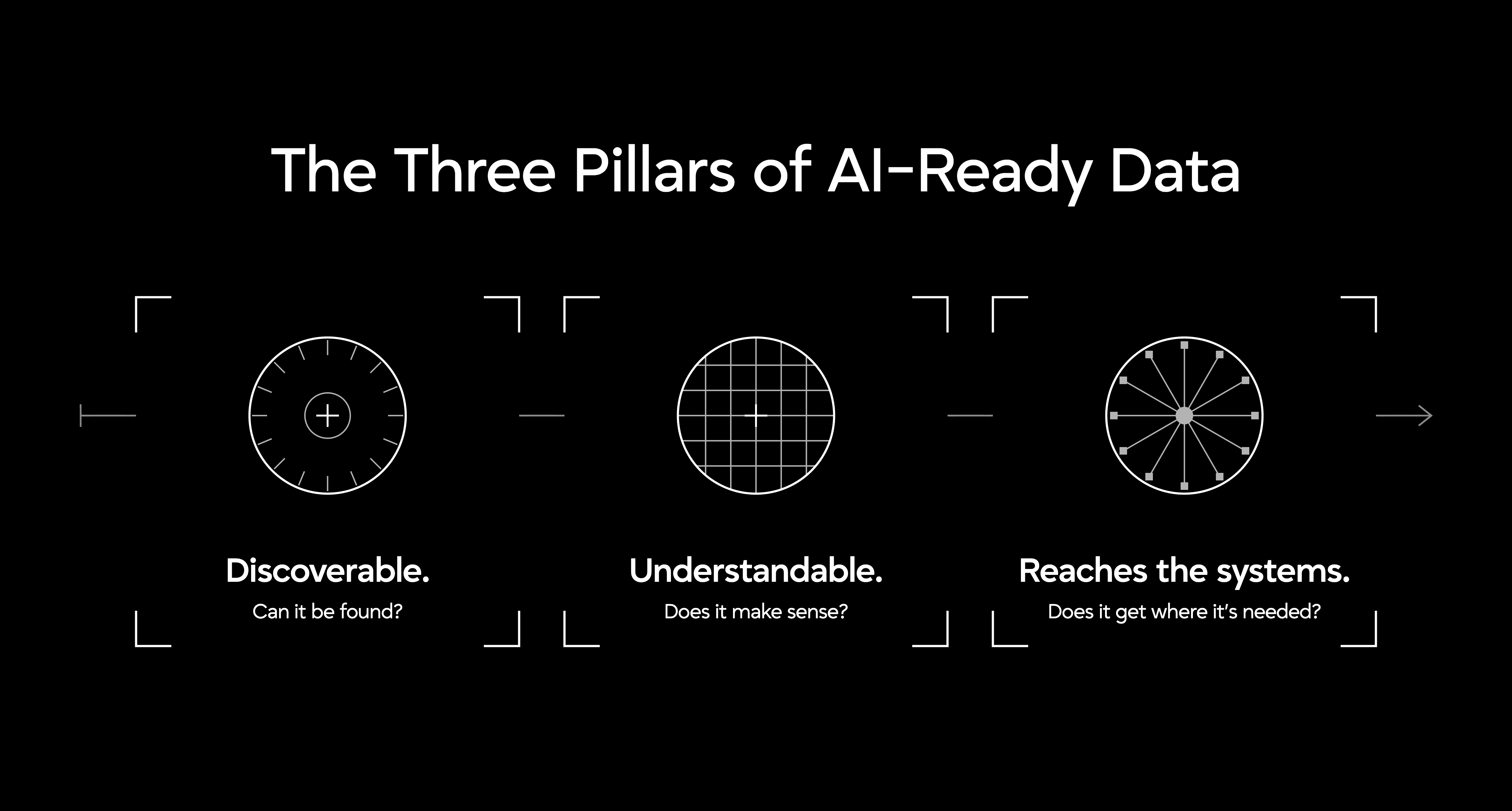
I've come to think about this problem in three parts, and I've come to believe that all three have to be true at once.
Is it discoverable? Can people, or the AI systems acting on their behalf, actually find the data? Most enterprise information fails this first test. It exists somewhere, sure, but nobody can actually put their hands on it when they need it.
Is it understandable? Once found, does it even make sense? Data without context doesn't actually tell you anything. Think of a field called "status_2" in a legacy system, a scanned PDF with no metadata attached, or a spreadsheet whose headers made perfect sense to someone who left the company four years ago. People struggle with this kind of thing every day in the non-AI world. AI struggles with it even more, because AI simply has no institutional memory to fall back on. It only knows what the data actually tells it.
Does it reach the systems that need it? Even if it's findable and understandable, getting the right information into the right model or workflow, in a form that system can actually use, is its own real discipline. It's also the step most AI rollouts skip, treating integration like an afterthought instead of the hard part it actually is.
Miss any one of those three, and the model's quality stops mattering. You've just built a very expensive way to produce answers you can't trust.
A live example: what happened with Google Earth
Last week gave us a live example of exactly this danger, playing out in the geospatial world specifically. Google rolled out a feature in Google Earth that let anyone type a prompt and generate a photorealistic image, fused directly onto real satellite imagery, at real coordinates. Within hours, people were generating convincing fake versions of sensitive real-world locations, and Google pulled the feature days later.
What made it dangerous wasn't that the images were fake. It's that they were, in Google's own words, "grounded in the real world," so they inherited the credibility of the actual map underneath them. As Henk van Ess, who broke the story on his Digital Digging newsletter, put it: a forgery built that way doesn't need to be convincing on its own, it borrows trust from the data it was built on.
Swap "satellite imagery" for whatever data your organization feeds its AI systems, and the risk is the same. It's not that the model reasoned poorly. It's that it reasoned very well on top of something that shouldn't have been trusted in the first place.
What the organizations pulling ahead are doing differently
The organizations making progress leveraging AI right now aren't the ones with the fanciest model access. That's commoditized at this point, everyone has it. They're the ones who treated getting their data ready as its own project, not a footnote to the AI project. That means actually going and looking at what data exists across the company, not just what's officially documented. It means doing the unglamorous work of making information findable and legible, to people and to machines, before pouring more money into the layer that consumes it. This work, often referred to as data governance, is an important step in the right direction.
That kind of work is easy to overlook because it's not the most exciting part. But it's the real work, and I've noticed the companies that do it well typically end up with something that compounds: AI that keeps getting more useful over time, because the foundation underneath it is actually improving instead of quietly aging and eroding.
The real first step
If your AI strategy still starts with "which model should we use," my reaction would be to gently push back on the starting point. The better question is whether your data is even in a state where any model could succeed with it. Can the right person, or the right system, actually find what they need? Would they understand it once they did? Does it even reach the tools you're asking to be intelligent in the first place? This approach doesn't just serve AI. The downstream benefits are equally important to every current use case and workflow.
Get the data right, and which model you choose becomes a much smaller decision than it feels like today.
AI will keep evolving. Models will change, capabilities will expand. But the organizations that come out ahead won't be the ones chasing every new release. They'll be the ones who invested early in making their data understandable, accessible, and trustworthy, because that foundation holds up no matter what the models do next.
Data readiness isn't an AI feature. It's a foundation. And it starts with knowing what information you actually have, and how to use it together.
This is the part of the AI story our team spends most of its time on at Voyager: helping organizations turn scattered, siloed information into data that's genuinely discoverable, understandable, and ready to power whatever they're building on top of it. It's not the flashiest layer of the AI conversation. But it's the first step, and I've become convinced it's the one that actually determines how the rest of the story unfolds.
Frequently asked questions
Why do most enterprise AI initiatives fail? Most AI initiatives stall not because of the model, but because of the data behind it. A capable model pointed at messy, ungoverned data can produce confident, convincing, and completely wrong output, which is often a bigger risk than the model simply failing outright.
What does "AI-ready" data actually mean? AI-ready data has to be discoverable (people and AI systems can actually find it), understandable (it has enough context to mean something once found), and reachable (it actually makes it into the model or workflow that needs it, in a usable form). All three have to be true at once.
Why is a model reasoning well on bad data more dangerous than a model that fails outright? Because the better a model reasons, the more convincing its wrong answers become. A failure is easy to catch. A wrong answer delivered with total conviction, especially one an autonomous agent might act on directly, is much harder to catch before it causes damage.
What should an organization do before choosing an AI model? Audit what data actually exists across the organization, not just what's officially documented, and invest in making it findable and legible to both people and machines. This is often called data governance, and it should happen before, not after, model selection.
Is data readiness a one-time project or an ongoing investment? Ongoing. Models and capabilities will keep changing, but a well-governed data foundation holds up regardless of what happens next in the model landscape, which is why treating data readiness as a permanent capability, not a project with an end date, is what separates organizations that keep improving from those that stall.
start a conversation